























Documentary on Nida Fazli 'Main Nida' bags National Award:Producer Atul Gangwar shares 'How a poem line laned the poet in trouble in Pakistan'
The documentary 'Main Nida', based on the life of late poet Nida Fazli, has received the 'Best Arts and Culture Film' award at the 72nd National Film Awards. Atul Gangwar, the producer of this documentary, has been very close to Nida Fazli ...

E
Entertainment
NEWS CARD

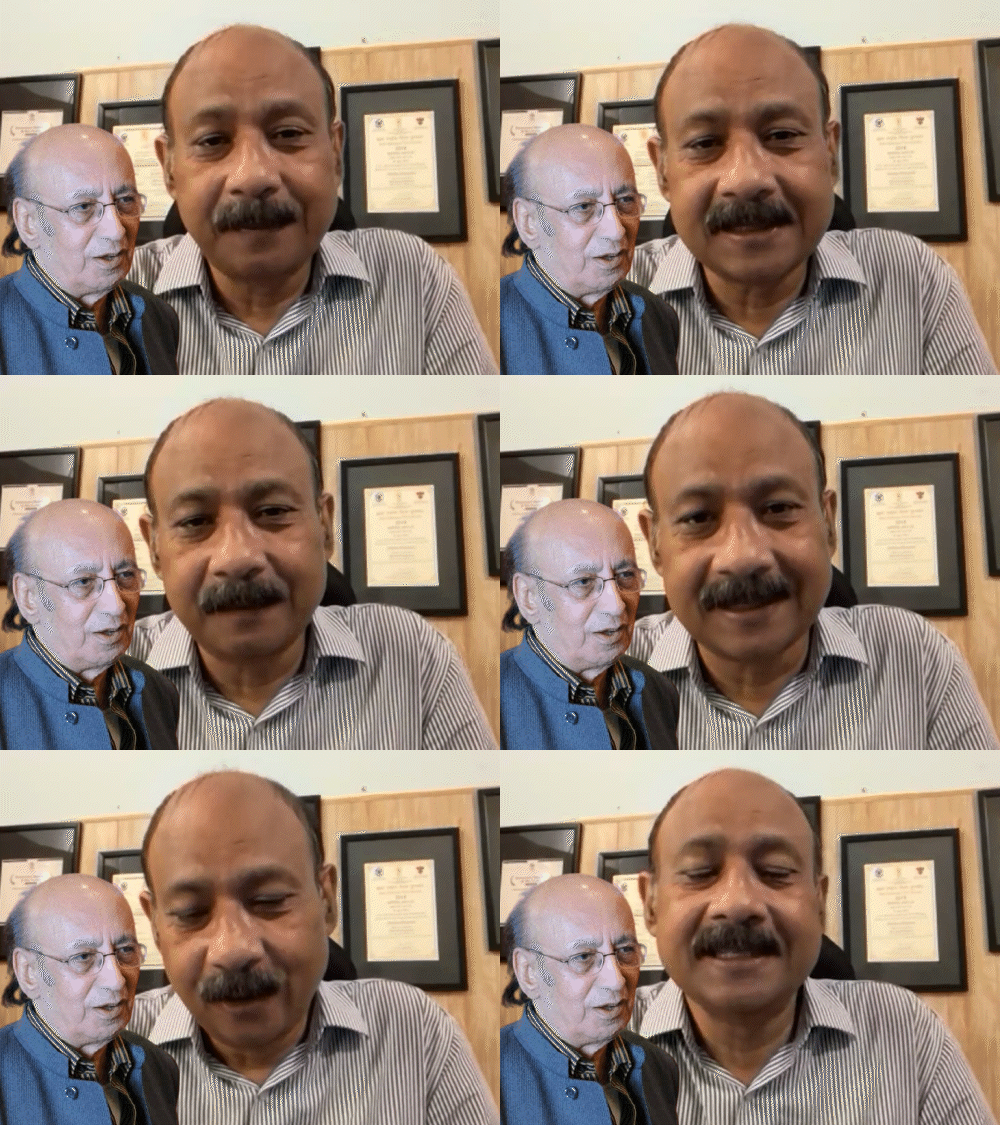
“Documentary on Nida Fazli 'Main Nida' bags National Award:Producer Atul Gangwar shares 'How a poem line laned the poet in trouble in Pakistan'”

Read more on
en.mttvindia.com
20 Jul 2026
The documentary 'Main Nida', based on the life of late poet Nida Fazli, has received the 'Best Arts and Culture Film' award at the 72nd National Film Awards. Atul Gangwar, the producer of this documentary, has been very close to Nida Fazli for about two and a half decades. He not only worked with him but also observed his personal life, struggles, relationships, and thoughts very closely. In a conversation with Dainik Bhaskar, Atul Gangwar shared many unheard stories about Nida Fazli's personal life, his family settled in Pakistan, the pain associated with his father, his friendship with Jagjit Singh, and many other aspects of his life. When did you first meet Nida Fazli? The first meeting was in 1998. We were making a show called 'Adabi Cocktail', and Nida Sahab was its writer. During that time, he introduced us to Talat Aziz Sahab, Mukri Sahab (Mohammed Umar Mukri), and many other prominent artists. That's where our relationship began, which continued for years. When did you finally feel that a documentary should be made on Nida Fazli's life? While working with him, I realised that he was not just a great poet, but also a great human being. Through him, I met Johnny Walker, Tun Tun, Hasan Kamal, Javed Siddiqui, Rakesh Bedi, and many other legends. He gave me a perspective on life. That's when I felt that his story should reach future generations. A large part of Nida Fazli's family had moved to Pakistan. Did he talk to you about this pain? Personally, he talked very little about this, but whatever he had to say, he would express it in his poetry. After his father's demise, when he couldn't attend his funeral, he wrote the famous nazm 'Tumhari Qabr Par Main Fatiha Padhne Nahin Aaya' (I did not come to read Fatiha at your grave). His entire pain is visible in it. How did Nida Fazli remember his mother and father? For his mother, he wrote - 'A mother like sour chutney on a fragrant gram flour bread.' Even today, if you read his poem for his father, your eyes well up, but in conversation, he never dwelled in the past. His entire focus was on the present and the future. Is there any incident associated with Nida Fazli that is still remembered today? Once I went to his house, and his hand was injured. I asked, "What happened?" Laughing, he said, "I was tired at the mushaira. On stage, I leaned back, thinking there was a tent behind me. It turned out there was nothing behind me, and I fell straight down." The biggest thing was that he could laugh heartily at himself. Any special anecdote related to Nida Fazli and Jagjit Singh that you still remember today? Once I needed a recommendation letter for a child. Nida Sahab called me to the airport. Jagjit Singh and K.S. Chithra were also present there. I had a blank piece of paper. Nida Sahab immediately wrote the recommendation by hand right there and had Jagjit Singh sign it. His quick wit and understanding were amazing. I remember one incident very well. I had a professor at Delhi University. Some documents of his niece needed to be signed. It was a kind of appreciation for her, stating that the child sings very well. So I spoke to Nida Sahab. He said, "I am coming to Delhi, so you come and meet me at the airport." When I reached there, I saw that Jagjit Singh ji, Chitra ji, and Nida Sahab were already there. I told him, "Sir, I need that letter from you." He said, "Bring it." I brought a paper from a nearby counter. When I reached him, he then told Jagjit Singh ji, "Come on, sign this." The paper was blank. Chitra ji was standing behind. Jagjit Singh ji looked back and Chitra ji was watching, wondering if he was signing a blank paper. Signing a blank paper is a big deal. Nida Sahab understood. He quickly wrote an appreciation letter by hand and then got Jagjit Singh ji's signature on it. How was the friendship between Nida Fazli and Jagjit Singh? Their relationship was not just professional, but very personal too. Jagjit Singh's most famous album 'Insight' featured ghazals written by Nida Sahab. They often sat together. The harmonium would come out, and new ghazals would be composed right there. Did Nida Fazli and Jagjit Singh ever have amusing banter? Once, an acquaintance of ours wanted to organise a Jagjit Singh show. I told Nida Sahab that if he spoke, perhaps the fee would be reduced. He said, laughing, "Don't take my name. If you take my name, he won't give you a discount; instead, he'll invite me to recite for free at some mushaira." Later, what happened was that Jagjit Singh kept his full fee, but arranged for the entire show's sponsorship. Meaning, there was no burden on the organizers. This was their friendship. What was the biggest challenge in making the documentary? The biggest challenge was compiling years of memories and footage. The second challenge was that the film industry doesn't remember writers as much as it remembers actors or directors. But those who truly knew Nida Sahab helped us in every possible way. Did any artist also help in this journey? Yes. Singer Shaan gave the interview without any hesitation. His father, Manas Mukherjee, was a very good friend of Nida Sahab. He spoke openly about the relationship between his father and Nida Sahab. This enriched the documentary. There was a lot of controversy over one of Nida Fazli's couplets in Pakistan. Yes. He had recited- 'The mosque is very far from home, let's do this, let's make a crying child laugh.' People asked if a child is greater than Allah? Nida Sahab replied, "Humans build mosques, but Allah himself creates the child. Now, who is greater, you decide." This was his philosophy. How much did Gwalior in his childhood influence his poetry? Very deeply. He started writing poetry after listening to Meera's bhajans. His entire body of work reflects the Ganga-Jamuni tehzeeb (syncretic culture) and Indian culture. That's why many people also call him the Kabir of the modern era. Has the hope for more films on such subjects increased after receiving the National Award? Absolutely. Until now, most documentaries have been made on big stars. But if a film made on a poet receives national honor, it will inspire other filmmakers to do serious work on literature and writers as well. Finally, what was the biggest lesson learned from Nida Fazli's life? That life should always be lived with a positive mindset. He struggled a lot, but never gave up. Whenever I read his poetry or relive his memories, I feel that no matter how many difficulties there are, one should never abandon hope and hard work.
rss_feed
Disclaimer
This is an unedited and auto-generated story from Syndicated News feed, MTTV India English Staff may not have modified or edited the content body.
link
Source:
Publisher:: Entertainment